

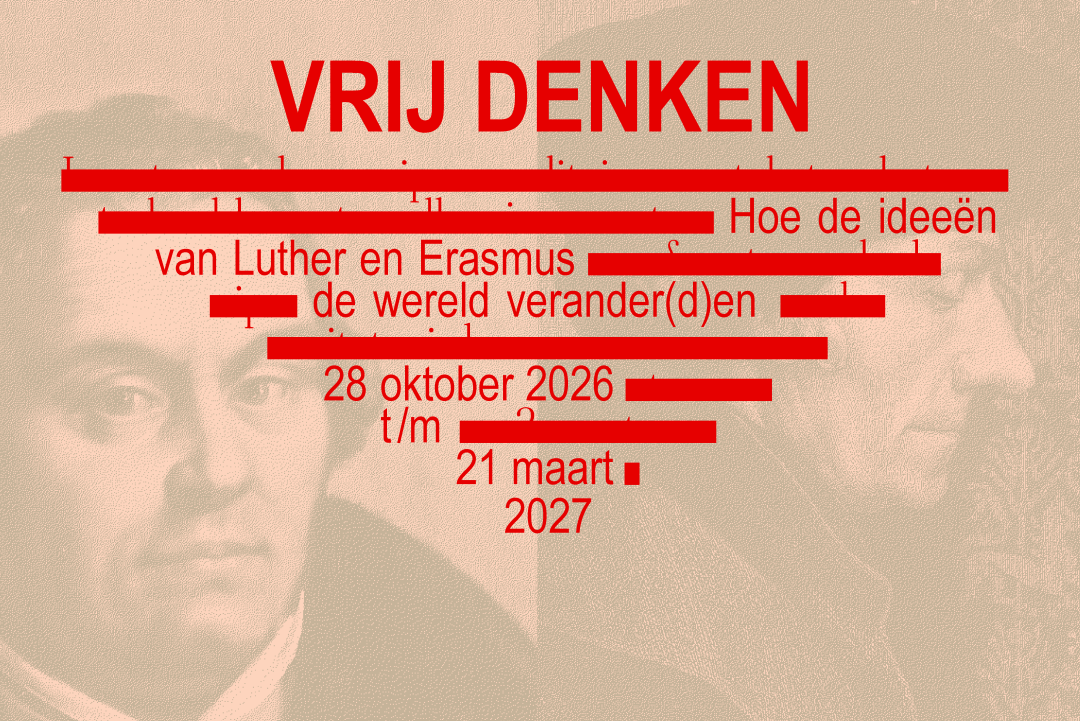
'Vrij Denken'

Opinions in the Netherlands seem to be becoming increasingly harsh and extreme, and the division between groups appears to be growing. Young people, too, are experiencing this polarization and are seeking connection. How can you take a stand without losing your ideals? This is the central theme of the exhibition 'Vrij Denken: How the Ideas of Luther and Erasmus Changed the World'. Discover how public debate on major themes took place 500 years ago. How do you remain in dialogue with one another, even when you are diametrically opposed?
'Vrij Denken': an exhibition at the Luther Museum
What does free thinking (vrij denken) mean when convictions clash? And how do you stay in dialogue with people who think fundamentally differently? In the exhibition, visitors discover the historical debate between Luther and Erasmus. How did these two scholars communicate in their time, and what was the influence of these writings? Through unique objects, the visitor discovers the viewpoints of Luther and Erasmus. The highlight of the exhibition is a rare printed work by Erasmus in which Luther made handwritten notes. Additionally, original prints by Erasmus from the Rotterdam Library collection are on display, as well as historical portraits of both thinkers.
In the second part of the exhibition, we get to work with visitors based on questions such as How do you express yourself? and How far will you go for your ideals? We connect different target groups, and at the end there is a special card game to continue the conversation, both in the museum and at home.
What were the positions of Luther and Erasmus? What was their debate about?
Remarkably, they showed many similarities in their criticism of the abuses within the Catholic Church. Their analysis of society may have been the same, but they differed fundamentally in their worldview and their vision of reform. Erasmus strived for reform of the church from within, while preserving unity. Luther opted for direct confrontation and a fundamental break: driven by religious conviction and a societal urge for reform, he initiated the Reformation (“Here I stand, I can do no other”) and with it Protestantism (protest!), which changed the world forever. The difference in thought and working methods is best seen in their famous polemical exchange on free will: Erasmus's *De libero arbitrio* (1524) versus Luther's *De servo arbitrio* (1525). Erasmus argued that man possesses a certain degree of free will and responsibility for his own actions. Luther argued that the human will is entirely subordinate to God's will. This exchange not only forms the core of their theological difference but also illustrates their divergent approaches to debate, persuasion, and action in a society where everything seemed to be in flux.
More information about the exhibition Free Thinking:
Art commission to Annabelle Binnerts and Lennart Lahuis
Our audience knows the Luther Museum for the connection between heritage, current events & art. In this case, we are commissioning an art piece from artist and writer Annabelle Binnerts (1995). Words are central to her work, which she executes on walls, textiles, and in books. Binnerts views words as shape-shifters that lead a double life, evoking ideas, objects, or experiences that exist elsewhere. In doing so, her work connects directly to the central question of the exhibition: how do words shape our view of the world? With this work for the museum, Binnerts explores how we try to get a grip on matters that are difficult to grasp, such as abstract ideas about matters like free will. She shows how language helps to organize the unknown, but also how it leaves room for ambiguity. By giving language a visual and spatial form, moments arise in which meaning is constantly being reshaped. Language is used in the artwork—just as with Luther and Erasmus—to evoke other worlds and as an instrument to describe and understand the world. It provides the exhibition with an imaginative but also a playful side.
“Playfulness is very important when it comes to language... As soon as something takes the form of written language, it acquires an image of serious theory, as if it were a task. People expect the text to contain the explanation of the sculpture they have come to see." - Annabelle Binnerts
In the garden, there will be a special weather vane by Lennart Lahuis (1986). Specifically for this exhibition, he is creating a sculpture of a so-called 'saying band'. He primarily uses natural processes such as erosion, evaporation, melting, and combustion, but also delves into subjects such as transience, time, disintegration, and history. For 'Vrij Denken', Lahuis is showing brand-new work, which he was able to create in collaboration with an artisanal ornamental blacksmith via a voucher from the Mondriaan Fund. In the Luther Museum, he presents a prototype of a language sculpture as a weather vane. Notes on Meteorology #1 (weather vane) is a working weather vane connected to a sensor that displays the local wind direction outside in real-time. registers. This wind direction is translated into movement and controls the direction indicated by the weather vane inside. Consequently, the viewer sees the work from a constantly changing angle: it is the wind that determines the readability of the text on the work. The weather vane consists of a long, curved metal ribbon and is a contemporary translation of the so-called spellband, a motif from classical painting and printmaking on which spoken or sung text was displayed and which was often depicted fluttering in the wind. The text on the weather vane explores the etymological development of the word 'scroll', from historical forms of the word to the contemporary 'scrolling'. The physical movement of this contemporary spellband and weather vane touches upon meanings that are also etymologically related to the word 'scroll': rolling, unrolling, and rotating. In this work, historical and contemporary forms of information transfer come together: scroll, spellband, weather vane, and digital scrolling. The history of language, the development of information technology, and the The transience of information is translated in this work into a weather vane that connects information flows with air currents. This exhibition is not a history lesson, but a mirror. Five centuries after their famous debate, Erasmus and Luther help us reflect anew on conviction, nuance, change, and the question of how we deal with differences.